Today’s societal challenges call for professionals who continue to develop their skills. Issues such as the energy transition are constantly evolving due to new legislation and regulations, technological innovations, and societal developments. Lifelong Development is therefore important not only for individual professionals but also for organisations and governments facing complex challenges.
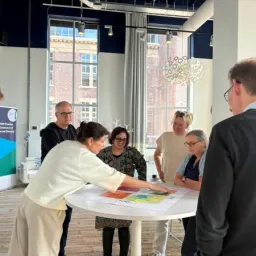
This was once again evident during the recent LLOGO Masterclass on Legislation in the Energy Transition in Utrecht. At this event, 22 local authority lawyers and policy officers gathered to deepen their knowledge of the legal and policy challenges surrounding the energy transition. The masterclass offered a combination of academic insights and practical applications, enabling participants to put what they learnt into practice immediately in their day-to-day work.
From legislation to practice
During the morning session, Rogier Kegge (Leiden University) provided an overview of the various areas of law that intersect within the energy transition. He discussed the tensions between existing legislation and the complex choices facing municipalities. In the afternoon, in-depth sessions on current issues followed. Regina Koning and Laura Spanjer (VNG) guided participants through the legal challenges surrounding grid congestion, whilst Tim Vlug (Erasmus University Rotterdam), with contributions from Alexandra Danopoulus, demonstrated which tools municipalities can utilize through land-use policy to support the energy transition.
The masterclass is part of LLOGO (Lifelong Development in the Built Environment), a partnership between the Association of Dutch Municipalities (VNG), the Municipality of Delft, Platform31, Leiden University, Erasmus University Rotterdam, Delft University of Technology, and The Hague University of Applied Sciences. The project supports municipalities with innovative learning solutions, enabling professionals to develop the knowledge and skills needed to successfully fulfil their roles in the energy transition. By closely linking education, research, and practice, LLOGO contributes to better-prepared municipalities and a sustainable societal impact.
Collaboration as the key to impact
This collaboration demonstrates what Leiden-Delft-Erasmus stands for: education and knowledge development that are directly linked to societal challenges. By bringing together the expertise of various knowledge institutions, a broader, more innovative and more practice-oriented range of learning opportunities is created than any institution could offer on its own. Professionals are exposed to new perspectives, disciplines and working methods, ensuring that knowledge is not only shared but also further developed collaboratively.
It is precisely this exchange of knowledge and expertise that is essential for tackling the challenges of our time. After all, societal issues such as the energy transition cannot be resolved by a single discipline or organisation. By offering professionals the opportunity to continue developing throughout their careers and to learn from different fields, Lifelong Development contributes not only to personal growth but also to the capacity of local authorities to tackle societal challenges.