

In South Holland, every square metre is fiercely contested. Housing, businesses, nature – how to deal with the increasing demand for space and the maze of rules and zoning plans? ‘Combine working and living more intelligently with new, sustainable industry, for example,’ advise area developers Tom Daamen and Gert-Joost Peek. By Maurice van Turnhout
What are the main bottlenecks in the distribution of space in South Holland in the coming years?
Tom Daamen: ‘In the Dutch planning system, we kept functions separate from each other for a long time. Working, living, industry, everything had to be neatly separated. For example, no homes could be built next to polluting industry. In many cases, outdated zoning plans are still being adhered to. But if you visit the location in question, you often find that innovation has transformed that industry into a different type of business. Think of the chemical company that now uses far fewer harmful substances in its production, or the greenhouse horticulture company that has started to focus on sustainable heating technology. Then it turns out that much more is possible.'
Gert-Joost Peek: 'Under the existing transitional law, many zoning plans have indeed been implemented indiscriminately, which means that we are not really exploiting the potential of the new Environment Act. That Act came into force last January and now offers excellent opportunities for more detailed spatial planning. A layered approach is taken, with water and soil quality as the starting point, which is also a major difference from previous legislation.’
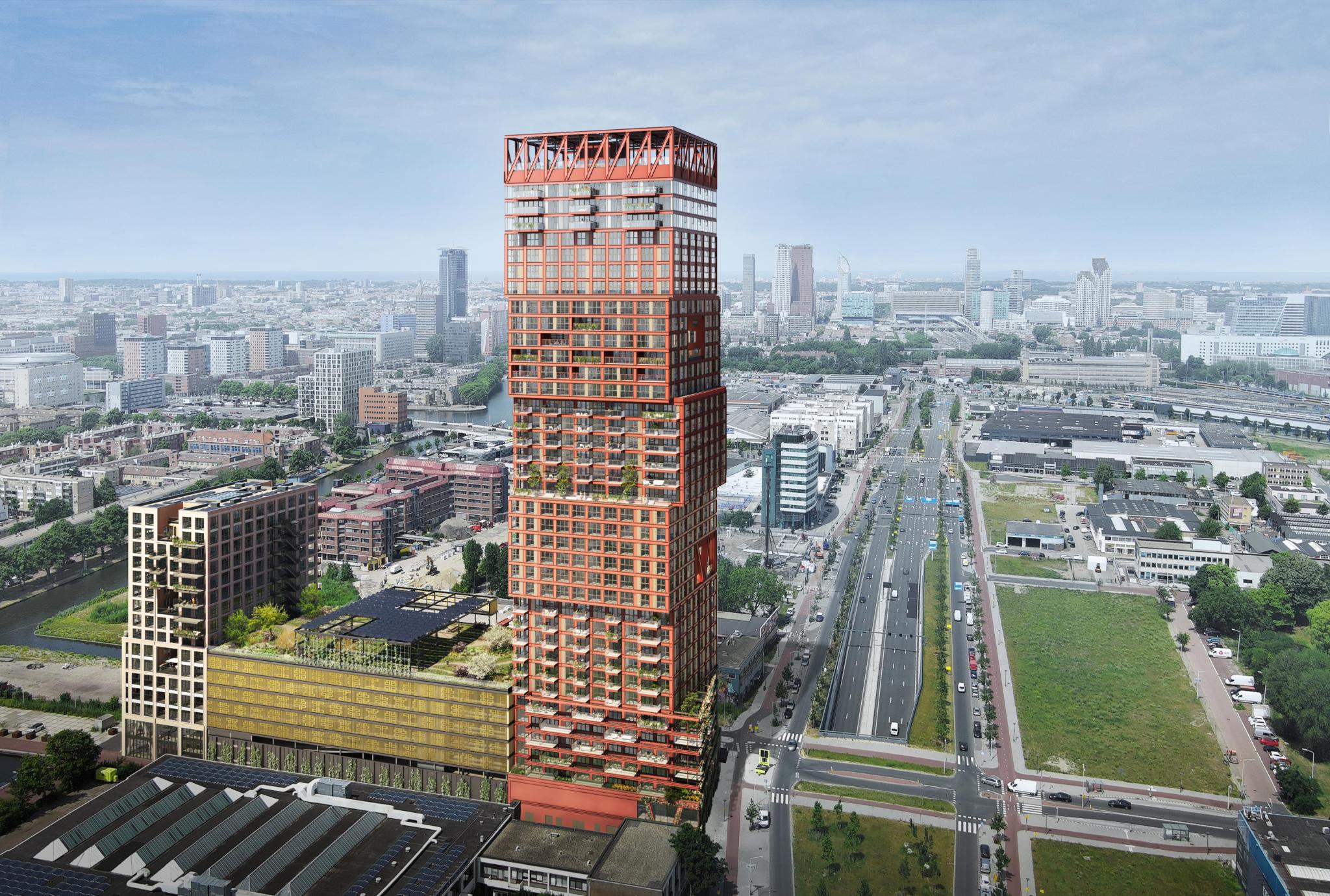
Daamen: 'Private parties, together with local and regional authorities, can utilise the expertise of planning lawyers to create more space in areas that appear to be completely sealed off on paper. Think of combining functions, through mixing or stacking. In the Sloterdijk area of Amsterdam, steel construction company OVEC had a building designed for such stacking; unfortunately, its realisation is still uncertain. According to current plans, this should also be possible in the Merwe-Vierhavens in Rotterdam or on the Schieoevers in Delft.'
The new highway in Rotterdam is almost finished, with the world's first energy-neutral tunnel.'
What might that look like in South Holland?
Daamen: 'If you look at economic functions, the transition to sustainable energy is now having a huge impact. Economic studies by Frank van Oort of Erasmus University, among others, point to an evolutionary approach, in which existing knowledge, skills and technology are converted into new, sustainable economic activities. In South Holland, for example, the offshore industry has started to focus on the production of wind turbines. The new motorway in Rotterdam is almost complete, featuring the world's first energy-neutral tunnel. Alongside this infrastructure, space can be created for multiple functions, including new sustainable industry.
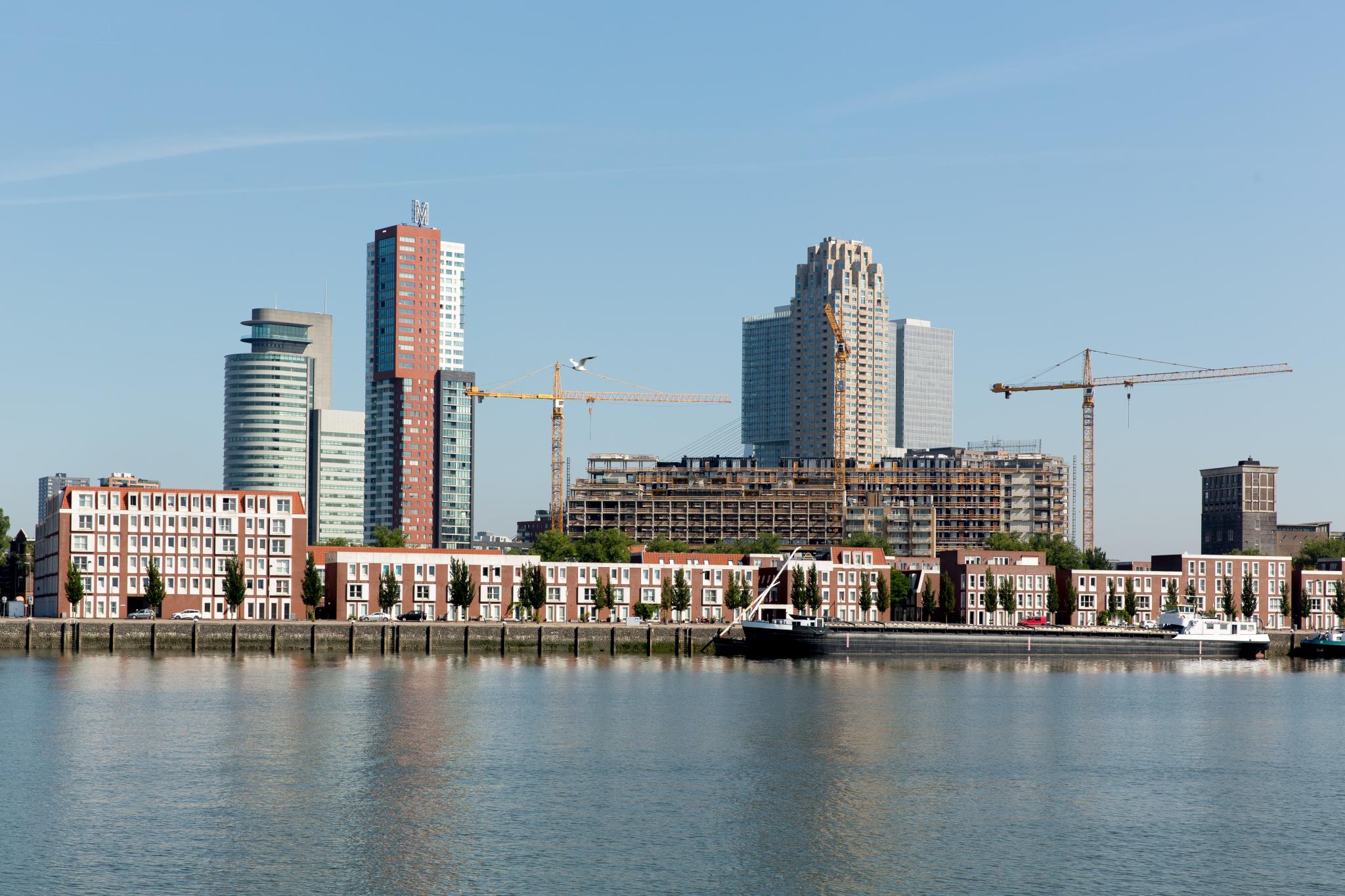
‘The major port companies are now dreaming of expansion with a Third Maasvlakte, but such an enormous investment must create sufficient added value for the Dutch economy. In any case, we should combine expansion with more intensive use and conversion of existing space.’
Peek: 'The European Commission has also set a goal to halt expansion at the expense of green space, agriculture and water storage by 2050: No Net Land Take. So it may well be that you will soon no longer be allowed to expand the existing area of urban functions.
'Making better use of what we already have is not only a sustainable principle, it also makes good financial sense. This also applies to housing construction. According to research by the Municipality of Rotterdam, a tower block with 400 homes generates less income from municipal taxes on average than 400 homes in an expansion district. However, a tower block generates millions of euros for the city after only a few years, in one case studied even almost 9 million euros, because you have already saved the costs of management and maintenance. The same 400 homes in an expansion neighbourhood take almost twenty years to achieve this, because there are more pipes and sewers, more roads to maintain, more outdoor space to manage, and so on.
What should the role of the government be in solving all spatial challenges?
Daamen: 'Large employers and investors in the region already regularly discuss policy with governments in order to align public and private investment power. Thanks to its logistics and ports, South Holland is not only a driving force behind the Dutch economy, but also the European economy. It is therefore advisable to continue to forge links between the province, the national government and Europe. This will enable you to claim European funds. And then national politicians will have to commit to a jointly agreed long-term vision, beyond the issues of the day.
'Private property, both domestically and internationally, is more difficult to manage, but it's precisely in those situations that it's beneficial to engage in dialogue. This is easily achievable with institutional partners. To keep citizens and SMEs involved in complex spatial issues, citizen consultations can also play a greater role. Last year, for example, around 7,500 citizens used the Participatory Value Evaluation (PVE) method to help assess the renewal of station areas along the Oude Lijn, the railway line between Leiden and Dordrecht. Should new stations be added, and what about preserving green spaces and parking facilities? More than half of the participants, for example, considered additional investments in improved public transport connections and cycle routes to the stations important. They felt a tunnel was too expensive; it would compromise ambitions they consider more important. Consequently, administrators started working on finding a cheaper alternative to a tunnel.'
Making better use of existing assets can also be justified financially.'
Peek: 'Even if you involve everyone in such a participatory process, you're bound to disappoint people. To prevent this, you must be able to explain why you ultimately make certain choices. And you must clarify in advance what citizens are allowed to form an opinion about but over which they have no influence, and also what citizens do have influence, and how they can subsequently exercise that influence vis-à-vis a government or consortium.
'Future stakeholders aren't always sufficiently involved in planning legislation; it often focuses primarily on existing interests. You see this in the Binckhorst neighborhood in The Hague, which has been transformed from an industrial estate into an urban district. Opportunities for mixing existed everywhere here, and as an entrepreneur, you're then fair game, because in ten years, a residential tower could easily be built next to your business premises. And then you're not going to invest in a new warehouse with equipment that local residents could complain about. To create legal certainty, part of the area in the second version of the Binckhorst environmental plan has been designated strictly for businesses. Naturally, densification was the starting point, for example, through stacked workspaces, because you don't want to return to the old zoning system.'
Are there any other inspiring breakthroughs in the battle for square meters?
Daamen: 'A quarter of a million homes must be built in South Holland by 2030, and there's clearly a lot of wishful thinking in that. But if you look at the long-term picture, we're not doing all that badly in the Netherlands. Think of the Merwede neighborhood in Utrecht, where owners have collaborated on programs—such as the placement of the many amenities associated with the 6,000 new homes in the area—to arrive at the best plan. Or consider the station areas of Rotterdam and The Hague, where space is intensively utilized for various mobility functions, from car to bus, train, and bicycle. Large offices on the first floors are becoming increasingly accessible to the public. The development of such areas is extremely expensive and often delayed for years by regulations and ownership structures, but in the future, the hard work will prove to be invaluable.'
Peek: 'I can agree with that optimism, as long as we continue to realize that people can be compromised if transitions are made too quickly.' Thanks to its excellent public transport accessibility, a city like London can easily stack houses. We already do this in the Netherlands, but our infrastructure isn't always designed for it. For example, the bus route in the Binckhorst district has been discontinued during peak hours – not because it's no longer needed, but because the roads are so congested that drivers can no longer meet their stop times. Sometimes, we act based on a future we dream of together, but which in practice is still quite a long way off.
In the future, the toil will prove to be of great value'
Dr. Ir. Tom Daamen is an associate professor of Urban Development Management at Delft University of Technology and director of the Foundation for Knowledge on Area Development. He leads research on governance issues surrounding complex spatial planning challenges, particularly in and around existing cities. He works closely with government agencies, housing associations, real estate developers, and institutional investors.
Dr. Ir. Gert-Joost Peek is a lecturer in Area Development and Transition Management at Rotterdam University of Applied Sciences. As the owner of SPOT-ON Consulting , he advises, speaks, and writes about urban area development. As a volunteer, he chairs Stichting I’MBINCK (I'MBINCK Foundation), an independent platform for the development of the Binckhorst district of The Hague.
 This article is from the new Leiden-Delft-Erasmus white paper 'The Economy of South Holland: Earning - Distributing - Changing'.