

The labour market in South Holland is struggling with a severe labour shortage. Economists Robert Dur and Paul de Hek see opportunities to do something about this. 'We need to place less emphasis on job security and more on work security.' There are also opportunities in education, and employers are too critical of applicants with disabilities. By Maurice van Turnhout
South Holland has a shortage of people in healthcare, education, technology and logistics. What can be done about this?
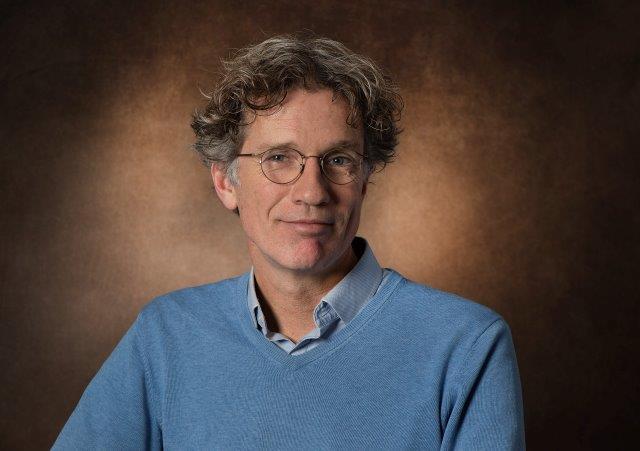 Robert Dur: 'It starts with education. When VMBO students choose an MBO programme, they often have little idea of the job market prospects. In a study involving 250 Dutch VMBO schools, pupils at some of the schools received additional information via a career platform. These pupils were told which professions are promising and which are not, based on estimates by the Research Centre for Education and the Labour Market (ROA) at Maastricht University.
'What did we find? Students were indeed influenced in their study choices. For example, the students we gave the extra information to chose a field of study where the expected hourly wage is 1.25 per cent higher and the job opportunities are 3 per cent better. And that's good for a tight labour market, because you're shifting the supply towards jobs that are in high demand.'
Sounds simple! Why isn't this happening everywhere?
 Paul de Hek: 'The education sector harbours a certain resistance to such rational economic considerations. They focus on the individual development of students, but in times of labour shortages, that is too one-sided. And for the time being, the number of students enrolling in technical vocational education programmes continues to decline. Between 2018/2019 and 2023/2024, that decline in South Holland was no less than 14 per cent.
'The solution lies not only in providing information and education to young people, but also in programmes such as Lifelong Development. Until 2024, every Dutch citizen could apply to the government for a grant for further training and retraining via the STAP budget. An evaluation by SEOR and Ockham IPS shows that unemployed people were able to find work more quickly. And people who already had jobs were more likely to move to other sectors than the control group, consisting of similar people without a STAP budget. Unfortunately, the government has cut the STAP budget, but I would recommend a similar programme for the future in order to cope with changes in the labour market.
Students were indeed influenced in their study choices.'

Is labour migration a good solution to labour shortages?
Dur: 'For most shortage occupations in the Netherlands, you can find a European country with a surplus of people in that occupation. It is still relatively easy to move within Europe and find work elsewhere. The fact that this is already happening on a large scale is also evident from the Dutch government's report on the state of migration: more than a quarter of all immigration is labour migration, double the proportion of asylum migration that is constantly discussed in political debates and the media.
De Hek: 'For some specialist professions, such as in engineering and healthcare, labour shortages can be solved through labour migration. But we sometimes forget that migrants do not only increase supply in the labour market. Like all other residents, migrants need housing, food, clothing, transport, healthcare, education and many other goods and services. Labour migration therefore also creates additional demand for labour and is therefore not a long-term solution. In greenhouse horticulture in the Westland region, for example, we also see exploitation and poor housing conditions for migrant workers, from which employment agencies profit.'
Shell is leaving the Maasvlakte, and other chemical companies are also about to leave South Holland. What does that mean for the labour market?
Dur: 'Given the labour shortage, it is certainly an opportunity, because it will free up people who can be retrained and upskilled for jobs in technology, healthcare, education and logistics. Retraining will not always be easy. And, of course, something will be lost for the people who currently work at chemical companies. They often feel a strong connection to the specific corporate culture.
'Unemployment benefits must ensure that people are at least financially compensated, especially if they have worked for a long time. And the UWV helps with data-driven techniques to find new career opportunities, taking much better account of labour market demand.'
De Hek: 'Many people who are now losing their jobs can find work in sectors with major staff shortages. According to calculations by the Social and Economic Council (SER), for example, by 2040 more than two million people will be needed in the healthcare sector in the Netherlands, which is one in four workers.'
Labor migration also creates additional demand for labor.'
So a chemical engineer should consider the possibility of working in the healthcare sector?
De Hek: 'In the future, I believe there should be less emphasis on job security and more on work security: the certainty of finding and keeping a job, but not necessarily with the same employer or in the same profession. Work security takes into account the changing labour market and the ability of employees to adapt and acquire new skills if they lose their current job. In my opinion, this does not mean a loss of freedom of choice in terms of work, quite the contrary. The chances of keeping your current job may decrease slightly, but on the other hand, you will have more opportunities to find and keep work.
In 2019, the South Holland Human Capital Agreement was concluded by 65 parties from education, government and the business community. The aim was to improve the labour market in the province. Two of the objectives are to offer flex workers more career prospects and to allow underutilised part-time workers to work more hours. Little progress has been made on these fronts so far. This is because projects within the Agreement often focus on technical sectors, where the number of flex workers is relatively low and the number of full-timers is relatively high.'

Are there any other ideas for remedying the labour shortage?
Dur: 'Employers often tend to be critical when it comes to job applications from people with disabilities, for example. People who use wheelchairs have difficulty finding jobs, even in professions where there are no significant physical obstacles for wheelchair users. If companies gain more experience with diverse candidates, this could help to reduce the labour shortage. There are already employers who have had positive experiences by casting their net a little wider. The employers' organisation VNO-NCW West could perhaps reinforce this message.'
People in wheelchairs have difficulty finding a job.'
De Hek: 'Colleagues at SEOR have conducted research into Open Hiring, whereby the first person to apply for a job gets the job, regardless of their work history or education. It is still a modest phenomenon, and it is not an option for all jobs, but it seems to work well for supermarkets, for example. It also eliminates discrimination and saves on costly job interviews. According to a national SEOR survey, 66 per cent of employers who use Open Hiring want to do so more often in the future. That's a promising sign."
Prof. Dr. Robert Dur is a professor of economics at Erasmus University Rotterdam and a research fellow at the Tinbergen Institute. He studies the motivations and behaviour of people in organisations, the labour market and government policy. In addition to theoretical research, he has conducted randomised field experiments in collaboration with companies and organisations in the public sector.
Dr. Paul de Hek is a project leader and senior researcher at SEOR Erasmus School of Economics. He previously worked at the Netherlands Bureau for Economic Policy Analysis. De Hek specialises in quantitative methods and techniques for researching policy issues related to social security and the labour market.
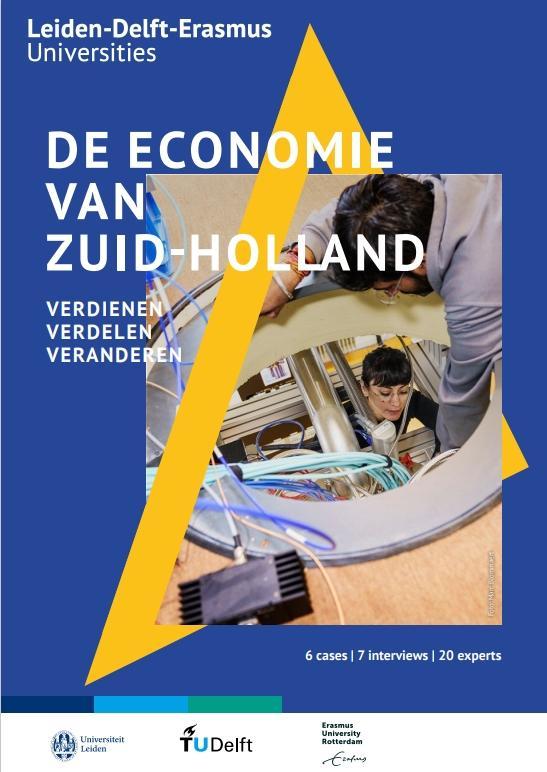 This article is from the new Leiden-Delft-Erasmus white paper 'The Economy of South Holland: Earning - Distributing - Changing'.