


From mathematicians and physicists to computer scientists and electrical engineers: they learn to work together in the Master's programme in Quantum Information Science & Technology (QIST). Companies can move forward with their skills to understand, design, and build quantum information processing. 'Our students feel that they are working on something special,' says programme director Miriam Blaauboer.
By Maurice van Turnhout
We asked companies: would you be interested in our graduates?'
Why 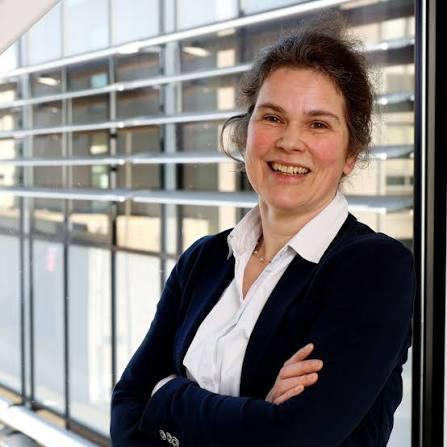 the Master's programme in QIST, Quantum Information Science & Technology? 'Delft and Leiden have always produced good researchers in the field of quantum. This is also where PhD students started the first Dutch quantum startups. We asked companies directly: if we set up a two-year quantum master's, would you be interested in our graduates? The answer was in the affirmative.
'QIST is not the only quantum programme in Europe, but its highly interdisciplinary nature does make us unique. In quantum companies, mathematicians and physicists work together with computer scientists and electrical engineers, and they all have to learn to understand each other's language in order to work together effectively. Companies saw it as a great advantage when people master this during their studies. That is why at QIST we put together multidisciplinary student teams, who have to start working on a concrete project right from the start of their studies. Not because of a resounding research result, but so that they learn to work together.'
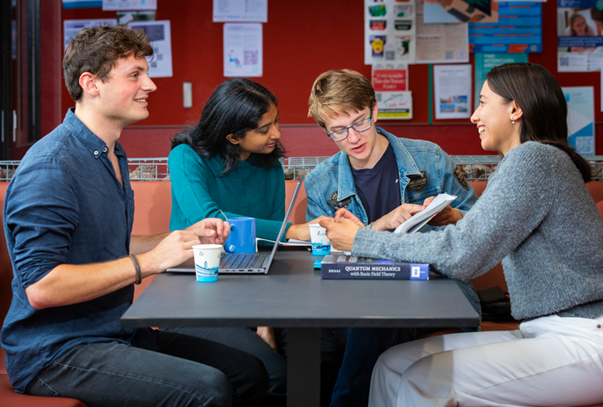
How does that work between those different students? 'Sometimes I hear that students talk past each other in the beginning or are bothered by gaps in each other's knowledge. But in the end, they learn to complement each other's competencies. An alumnus of our first batch has been working at a quantum company in Singapore for a few months now. He emailed me that he learned to work in an intercultural team at QIST, and that this helped him enormously in his first job.
'With forty-five students, we only have a small programme here, but it is a very close-knit and motivated group. All students feel like they are working on something very special.'
What is the sp ecial thing about the collaboration between Delft and Leiden at QIST?
'Even before this master's existed, Delft and Leiden worked together a lot in the field of STEM as well, so it felt logical to do QIST together as well. Our expertise is complementary. In short: Delft is strong in the hardware side of quantum, making qbits practical. Leiden excels in the software side: developing quantum algorithms. We try to integrate this by having lecturers from Delft and Leiden teach subjects in pairs.
'In the Dutch Research Agenda, the Dutch government identified ten key technologies that need to be supported, with quantum in second place. Yet I also speak to students who find the study too uncertain, because the quantum computer may never materialize.'
Does the fact that quantum controls the news less than AI and appeals less to the imagination play a role in this? 'AI is a language model of which every internet user can download a free version, which is more accessible. Quantum also develops much more slowly. Nevertheless, quantum researchers are now taking all kinds of interesting side paths. It is expected that between now and 2030, quantum computers will be built that still contain a certain amount of 'noise', but which will still have their uses. And there are already small-scale applications, such as the quantum-secure connection between The Hague, Rijswijk and Delft.
'Half of our first batch of students found work at a quantum company, in the Netherlands or elsewhere in the world, before graduating. So the field is not that uncertain.'
It would be a shame if the influx of foreign students is curbed'
What advice do you have for policymakers who want to stimulate quantum? 'Recently, there was a lot of debate about the influx of international students. To put it bluntly, they would occupy places of Dutch students. I think that is too short-sighted reasoning. At QIST, roughly half of the students have a Dutch prior education, the other half come from abroad. I would think it would be a great shame if that influx were to be curbed, because quantum is pre-eminently an international field. It is actually healthy for the Dutch economy if our students end up in positions worldwide where they can help and support each other.'
What kind of ambitions do the students have? 'Some students want nothing more than to set up their own quantum startup. They often want to do PhD research first, because there are inspiring examples in Delft of PhD students who now run such a startup with a contagious pioneering mentality. And there is also a minority that prefers to continue doing specialized research. Another part goes into technical consultancy.'
In Leiden, we offer a quantum awareness course for interested laymen
Can laypeople also learn something from you about quantum and its impact on their work? 'In Leiden, we offer a quantum awareness course for interested laypeople. For example, people in the banking sector have questions that are mainly driven by fear: what if the quantum computer comes along and it becomes possible to crack all existing cryptography? The government is also concerned about this, with all its encrypted state secrets. But there is also interest in the opportunities that quantum offers: the secure encryption of information, the development of new medicines.
'As with AI, we have to be careful not to overdo it in positive or negative hype. That is why the ministries are now jointly developing a government-wide quantum strategy. Based on questions such as: what is needed, where are the vulnerabilities, how are we going to organize quantum and maintain our level of knowledge? These are all questions that QIST's students can help answer.'
Miriam Blaauboer is Professor of Theoretical Physics at TU Delft and Programme Director of the Master's in Quantum Information Science & Technology (QIST). In 2025, she was elected TU Delft's Lecturer of the Year for her accessible teaching on complex subjects.
This is a pre-publication from the new white paper Quantum Talent by Leiden-Delft-Erasmus Universities. This paper will be presented on 10 December in the Provincial Government Building in The Hague. More information can be found via the link below.