

The transition toward net-zero aviation is one of the most complex sustainability challenges of our time. No single technology, policy, or innovation can deliver a net-zero emission aviation sector on its own.
There is no silver bullet. Much like the broader climate crisis, aviation’s transformation requires a systemic approach, cross-sector collaboration, and a willingness to rethink assumptions.
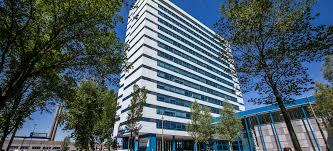
It is precisely in this landscape of complexity that the Leiden–Delft–Erasmus (LDE) Thesis Lab “Sustainable Aviation” has established itself as a unique and increasingly indispensable platform. After four successful years, the program’s continuation by connecting to Flying Vision Accelerator, part of Luchtvaart in Transitie (Aviation in Transition) and the faculty of Aerospace Engineering of Delft University of Technology, covering (part of) the aviation sector, signals strong recognition of its value, both for industry and academia.
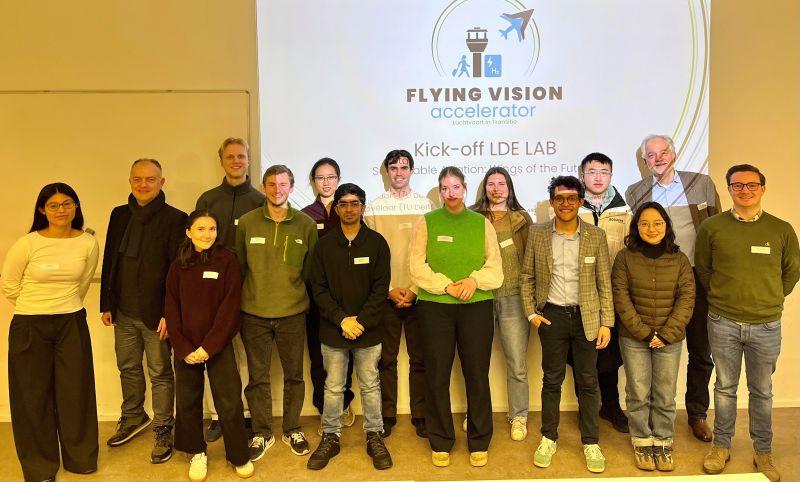
During the Kick-Off of this years’ LDE Thesis Lab “Sustainable Aviation; Wings of the Future” earlier this month this became very clear, as 15 students started on cases, based on Key Research questions from the Flying Vision Accelerator’ Think Tanks, and guides by industry partners Royal NLR, Airbus and Elysian.
Students as Catalysts for Sector Innovation
A defining strength of the Thesis Lab is its deliberate commitment to interdisciplinarity. Students from nine different study programs such as aerospace engineering, air and space law, management, governance, strategic product design and complex systems engineering come together to work on real-world challenges provided by major stakeholders. The diversity in disciplinary backgrounds is not accidental; it mirrors the multifaceted nature of the complex aviation transition.
Bold ideas
Industry partners consistently emphasize the value of students’ fresh ideas, analytical openness, and future-oriented mindset. Their ability to question existing practices—unburdened by ingrained assumptions—creates fertile ground for creative thinking. As highlighted in the 2025 Thesis Lab Green Skies sessions, students contribute bold ideas while industry experts respond with complementary insights grounded in experience. This interplay fosters a dynamic learning ecosystem where established knowledge meets emerging perspectives.
Students also bring energy and intrinsic motivation, which helps keep the momentum high even in the face of highly complex or uncertain research questions. The final events of past Labs regularly brought together dozens of industry experts who gained inspiration from the students’ findings and methods. The fact that the aviation sector has chosen to continue hosting the Lab beyond 2025 demonstrates how valuable this youthful perspective has become in the industry’s long-term transformation strategy.

Real-World Challenges, Real-World Impact
The Lab’s approach is grounded in tackling authentic challenges provided directly by companies and public organizations.
These questions range widely, for example:
- Understanding passenger engagement with decarbonized aviation fuels.
- Assessing legal and safety implications of emerging technologies.
- Investigating closed-loop supply chains and consumer engagement
The holistic nature of these problems requires students to integrate environmental science, engineering, economic modelling, design methods, legal analysis, and systems thinking. By working closely with the partner organizations, students experience the operational realities that shape innovation—economic constraints, safety regulations, stakeholder complexity, and long technology development cycles.

At the same time, industry receives actionable insights: new conceptual ideas, comparative assessments, scenario analyses, and user-centered perspectives through the expansion of the Lab under the Flying Vision Accelerator. The Accelerator’s mission is to foster sector-wide collaboration to develop a roadmap that identifies milestones and research pathways required to support the aviation industry’s 2050 decarbonization targets. This aligns perfectly with the Thesis Lab’s interdisciplinary methodology.
Using System Dynamics Tools: Learning from En-ROADS
A notable educational and analytical component in the Lab’s ecosystem involves using systems-thinking tools such as En-ROADS, developed by Climate Interactive and MIT Sloan. Although not exclusive to aviation, En-ROADS helps students understand the interdependencies between technological, policy, and behavioral variables that shape global emissions trajectories.
Tools like En-ROADS allow students to experiment with different interventions—changes in energy carriers, renewable fuel uptake, efficiency improvements, carbon pricing, or consumer behavior—and observe their combined effects on climate outcomes. This approach mirrors the aviation challenge itself: electrification, hydrogen, alternative aviation fuels, operational improvements, circular material streams, and demand management all interact in non-linear ways. No single intervention delivers success alone.
This mirrors aviation’s reality: there is no silver bullet, but rather a portfolio of interconnected pathways that must evolve together. The Thesis Lab’s recurring emphasis on systems thinking, interdisciplinary reasoning, and dynamic roadmapping aligns strongly with the conceptual foundations behind tools like En-ROADS. These tools provide a structured method for identifying leverage points and for understanding where innovation can create systemic, not just incremental, change.
A Platform for Long-Term Transformation
Perhaps the greatest contribution of the LDE Thesis Lab is its role as an innovation-ecosystem where students and professionals jointly explore the uncertainties of a sector undergoing profound transformation. The aviation industry’s commitment to continuing and expanding the Lab demonstrates that this collaboration is more than educational—it is strategic.
As the Lab integrates more deeply with the Flying Vision Accelerator, students will play an increasingly central role in shaping the future of aviation. Their abilities to explore unconventional ideas, engage with emerging ethical questions, analyze complex systems, and envision long-term futures are precisely what the sector needs now.
The challenges are immense: reducing energy demand, adopting novel energy carriers, enabling circular aircraft economies, and redefining the passenger behavior of 2050. But with collaborative platforms like the LDE Thesis Lab, the sector gains a continuous pipeline of new thinkers ready to confront these uncertainties.