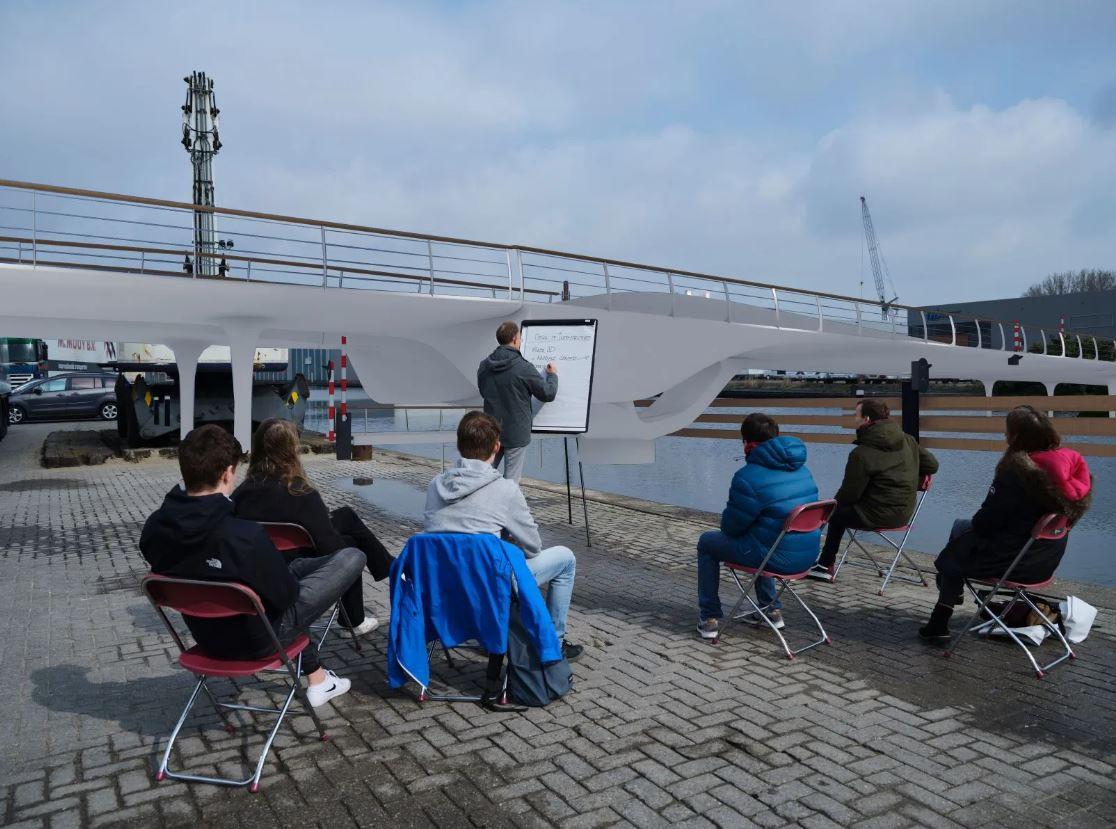


Every year, around five students from Leiden University's bachelor's programme in Urban Studies join the minor Integrated Infrastructure Design at TU Delft. Among a group of thirty students — mostly from Mechanical Engineering, Civil Engineering and Architecture — they stand out. Not because they struggle to keep up, but because they bring something that enriches the group.
A different perspective on the built environment
Transport and water infrastructures have a profound impact on the living environment. Yet within technical degree programmes, the focus understandably lies on the infrastructure itself — a challenge that is already complex enough. What Urban Studies students bring is a deep understanding of social structures and dynamics in the living environment. That goes beyond a single module on 'social aspects' within a technical curriculum. Developing knowledge of the social domain requires a dedicated, full-fledged programme — and that is exactly what these students have completed.
 Former coordinator Hans de Boer: 'Every student approaches a challenge from the mindset and knowledge they have developed during their first years of study. Bringing together students from different fields is key to arriving at appropriate solutions in which both infrastructure and the living environment are approached and designed in balance.'
A logical step for Urban Studies students
For students in Leiden's Urban Studies bachelor's programme, the minor is also strategically a smart choice. There is no Leiden master's programme that directly connects to their degree — those wishing to continue in a spatial direction must go to the University of Amsterdam, while the Architecture master's at TU Delft is not directly accessible without a technical background.

The minor Integrated Infrastructure Design offers a bridge: students prove well able to follow the content, even without an exact science profile, while simultaneously building a technical foundation that broadens their master's options.
It is notable that international students are disproportionately represented among those who take this step. It seems they are quicker to recognise — and appreciate — the added value of doing a minor at another university.
Room for more diversity
After eleven years, De Boer still sees opportunities to broaden the mix further. Given the public character of infrastructure — in decision-making, funding and use — students of Public Administration from Leiden or Rotterdam would be a valuable addition. So far, they have not found their way to the minor. The same applies to Business Administration students, though the affinity with infrastructure design is less obvious there. Students of Systems Engineering, Policy Analysis and Management are represented, but that remains largely a Delft affair.
The collaboration between Leiden, Delft and Erasmus provides exactly the structure to make this kind of cross-pollination possible. The minor Integrated Infrastructure Design shows what happens when you bring students from different worlds together to work on complex challenges — and that it works.